

How to Get Rid of Fungus Gnats in Houseplants (For Good)

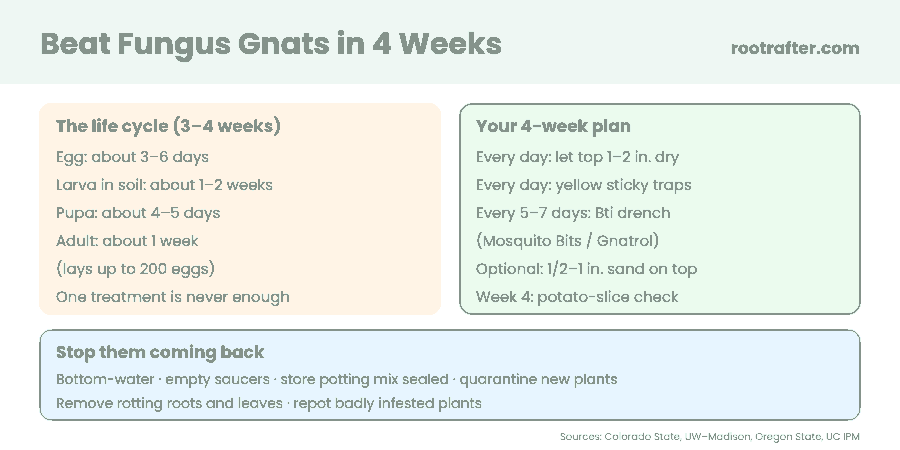
To get rid of fungus gnats, you have to break their life cycle: let the top inch or two of soil dry out between waterings, catch the adults on yellow sticky traps, and kill the larvae in the soil with Bti (sold as Mosquito Bits or Gnatrol). Repeat the Bti every 5–7 days and keep going for three to four weeks. One treatment never works, because new gnats keep hatching from eggs already in the soil.
Quick Answer: The 4-Step Plan
- Dry the soil. Let the top 1–2 inches dry before watering again (Colorado State). Empty saucers.
- Trap the adults. Put small yellow sticky traps in each pot.
- Kill the larvae. Water with a Bti drench every 5–7 days (UW–Madison, UC IPM).
- Keep going for 3–4 weeks to catch every new generation.
What Are Fungus Gnats?
Fungus gnats are tiny, dark, weak-flying insects that hover around houseplants and run across the soil.
- Adults don’t bite and don’t damage plants (UC IPM, UW–Madison). They’re just annoying.
- Larvae (tiny clear worms with black heads) live in the soil and feed on fungi, algae, decaying matter and sometimes plant roots (Colorado State). They mostly stay in the top 2–3 inches of soil.
- Large numbers of larvae can damage roots, especially on seedlings and young plants (UC IPM, Oregon State).
Fungus gnats vs fruit flies: fruit flies hang around fruit bowls and bins; fungus gnats stay near plant pots. UW–Madison notes that vinegar traps meant for fruit flies don’t work for fungus gnats.
Why They Keep Coming Back: The Life Cycle
| Stage | How long |
|---|---|
| Egg | About 3–6 days |
| Larva (in soil) | About 1–2 weeks |
| Pupa | About 4–5 days |
| Adult | About 1 week (lays up to 200 eggs) |
Sources: UW–Madison Extension, Colorado State Extension.
From egg to adult takes three to four weeks at room temperature (Colorado State, UW–Madison), and as little as about 17 days at 75°F (UC IPM). That’s why you need to keep treating for at least a month. Kill the adults and the larvae keep hatching; kill the larvae once and new eggs replace them.
Step 1: Check Your Plants (Potato Test)
To find which pots are infested, push 1/4-inch slices or chunks of raw potato into the soil, cut side down. After 3–4 days, lift them and look for larvae underneath (Colorado State, UW–Madison).
Step 2: Let the Soil Dry Out
Larvae need constantly wet soil. This is the most important step.
- Let the top 1–2 inches dry between waterings (Colorado State). Oregon State and UW–Madison say at least the top inch.
- Water from the bottom, so the surface stays drier (UW–Madison, Oregon State).
- Don’t leave water in saucers (Oregon State).
Most houseplants are fine with this. Check our care guides for pothos, succulents and orchids for how often each one really needs water.
Step 3: Trap the Adults With Yellow Sticky Traps
Adult fungus gnats are attracted to yellow.
- Cut traps into small squares and stick them on skewers in each pot (UC IPM).
- Replace them every few days as they fill up (Oregon State).
- Keep them away from pets and small children.
Important: traps only catch adults. UW–Madison says traps alone won’t control the larvae. They’re mostly a way to cut egg-laying and see whether numbers are going down.
Step 4: Kill the Larvae With Bti
Bti (Bacillus thuringiensis israelensis) is a natural bacterium that kills fly larvae. It’s the active ingredient in Mosquito Bits and Gnatrol.
- UC IPM says it is toxic only to fly larvae.
- It doesn’t kill eggs, pupae or adults (UW–Madison).
- How to use it: soak the granules in water for about 30 minutes, then water the plants with that water (Oregon State).
- Repeat every 5–7 days for several weeks (UW–Madison, UC IPM), because Bti doesn’t last long indoors.
Follow the product label for amounts.
Step 5: Add a Sand or Gravel Top Layer (Optional)
Cover the soil with 1/2 to 1 inch of coarse sand or fine gravel (UW–Madison). It dries fast, so adults can’t lay eggs in damp soil. UW–Madison says it may take 3–4 weeks of drier watering plus a sand or gravel layer to break the cycle.
Step 6: Fix the Source
- Use pasteurized potting mix and store opened bags sealed and off the ground (UC IPM, Oregon State).
- Remove rotting roots, leaves and bulbs from pots (Colorado State, Oregon State).
- Quarantine new plants for a few weeks before putting them with your others (Oregon State).
- Repot badly infested plants in fresh mix. Oregon State even suggests replacing a plant that keeps failing.
What About Beneficial Nematodes?
The nematode Steinernema feltiae is “particularly effective” against fungus gnat larvae, says Colorado State, and kills them within 3–4 days. Nematodes are sold by mail order, are live and perishable, and work best in moist soil between 60°F and 90°F (UC IPM). They’re a good option for big plant collections.
Do You Need Insecticide?
Usually not. UC IPM says insecticides are “rarely warranted” for fungus gnats in homes, and UW–Madison says chemical controls aren’t needed unless an infestation is severe. Colorado State lists products for persistent problems that last several weeks. If you do use one, read the label and treat plants outdoors where possible.
What About Hydrogen Peroxide, Neem and Cinnamon?
You’ll see many home remedies online and on Reddit. Hydrogen peroxide drenches are very popular, but none of the four extension services we checked recommend them, so we haven’t included them in the plan. Reddit users also often report that neem oil doesn’t help much with fungus gnats. Stick with the proven basics: dry soil, traps and Bti.
7 Fungus Gnat Mistakes Real People Make (From Forums)
- Watering on a schedule instead of checking the soil. Constantly damp soil keeps the cycle going.
- Treating once and stopping. New gnats hatch from eggs for weeks.
- Relying on sticky traps alone. They don’t touch the larvae.
- Expecting Bti to kill adults. It only kills larvae, so adults fly around for another week or so.
- Using a bag of potting mix that’s already damp and stored openly. Gnats can come home with the soil.
- Leaving water in saucers and cachepots.
- Ignoring rotting roots. Larvae thrive on decaying matter.
FAQ
How long does it take to get rid of fungus gnats?
About 3–4 weeks of drier watering and repeated Bti treatments (UW–Madison).
Do fungus gnats hurt plants?
Adults don’t. Large numbers of larvae can damage roots, especially on seedlings and young plants.
Can I use mosquito dunks for fungus gnats?
Yes. Mosquito Bits and dunks contain Bti. Soak them in water and use that water on your plants every 5–7 days.
Will fungus gnats go away on their own?
Rarely, while the soil stays moist. Drying the soil is the single biggest fix.
Final Thoughts
You can’t beat fungus gnats with one spray. You beat them by breaking the life cycle for a month: dry soil, yellow traps for adults and Bti every 5–7 days for the larvae. Fix overwatering and they usually won’t come back.
More houseplant guides: Christmas cactus care and rex begonia care.