
Jacaranda Tree: Growing Zones, Blooms, Care and Problems

The jacaranda tree (Jacaranda mimosifolia) is the famous “purple tree” that covers streets in lavender-blue flowers each spring. It comes from South America, grows fast, and in the US it only thrives outdoors in warm, nearly frost-free places: USDA zones 9b to 11, which means mainly South and Central Florida, Southern California, the low deserts of Arizona and the warmest parts of Texas. Give it full sun, well-drained soil and early pruning, and plant it where its flower drop won’t be a nuisance.
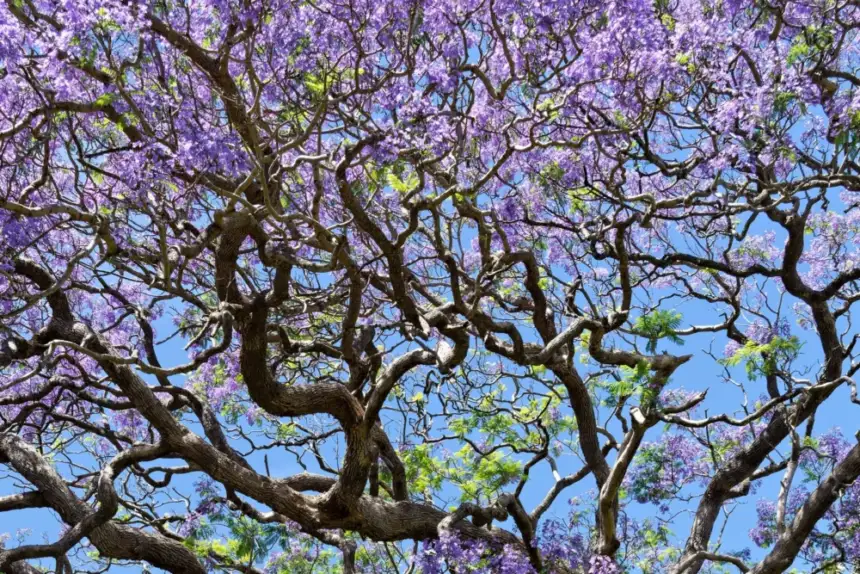
Jacaranda Tree at a Glance
| What | Details |
|---|---|
| Botanical name | Jacaranda mimosifolia (blue jacaranda) |
| Native to | South America: Bolivia, Argentina, Paraguay and nearby areas |
| Growing zones | USDA 9b–11 (some sources say 10–11 for reliable bloom) |
| Cold tolerance | Established trees survive brief dips to about 19–20°F |
| Mature size | About 25–50 ft tall and 15–60 ft wide |
| Growth rate | Fast; up to 10 ft a year when young in warm climates (NC State) |
| Bloom | Lavender-blue flowers in spring to early summer, lasting up to about 8 weeks |
| Light | Full sun |
| Soil | Well-drained; does not like heavy, wet soil |
| Water | Drought tolerant once established; water in long dry spells |
What Does a Jacaranda Tree Look Like?
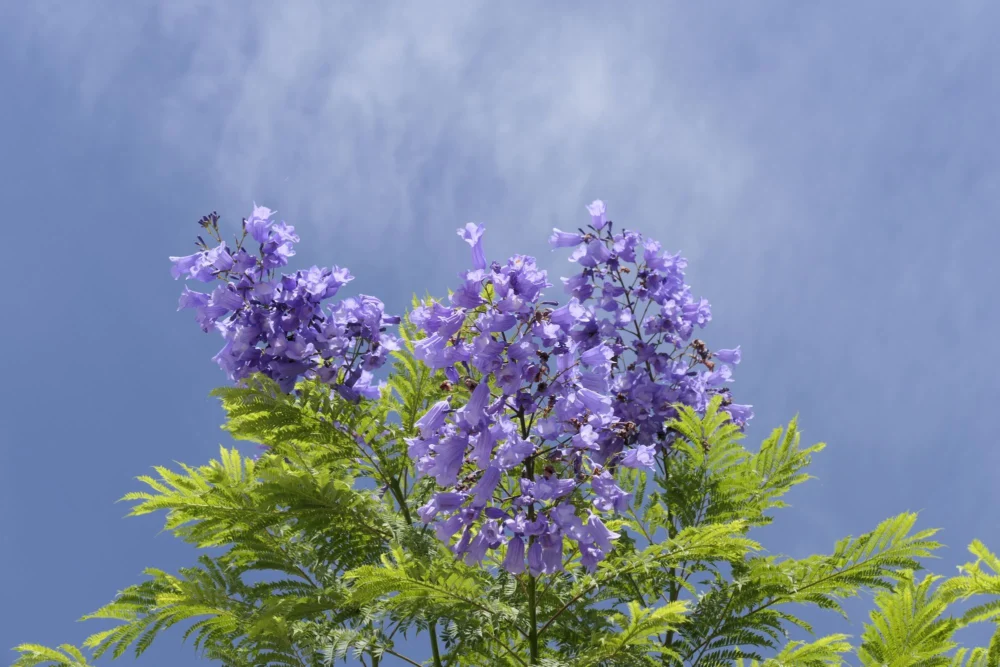
- Flowers: clusters of trumpet-shaped, lavender-blue to purple flowers, each about 1–2 inches long, in bunches up to about a foot long. They are lightly fragrant and attract bees. A white form also exists.
- Leaves: large, fern-like leaves made of many tiny leaflets (botanists call them bipinnate). They give the tree a soft, feathery look even when it isn’t flowering.
- Shape: an open, spreading, umbrella-like crown, often wider than it is tall.
- Seed pods: round, flat, woody discs about 2–3 inches across that split to release papery, winged seeds.
The tree usually drops many of its leaves in late winter or spring and then flowers, often on bare or nearly bare branches, before the new leaves fill in. Sources disagree on the label: NC State and UF call it deciduous, while nurseries such as Monrovia call it semi-evergreen.
Where Do Jacaranda Trees Grow?
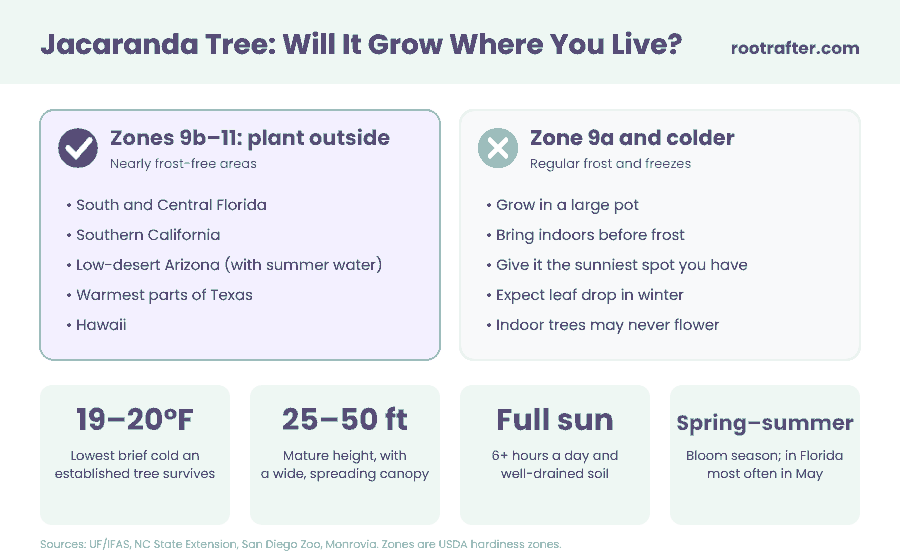
Jacarandas need warmth. UF/IFAS lists USDA zones 9B through 11, NC State lists 9b and warmer, and Monrovia sells it for zones 10–11.
Cold: established trees can handle short dips to around 19–20°F (Wikipedia, San Diego Zoo). Young trees are much more tender. If frost kills a young jacaranda to the ground, it often sprouts again from the roots, but it may grow back as a shrubby, multi-stemmed plant.
In the US, that means:
- Florida: South and Central Florida. UF notes it often blooms best after a winter with several nights in the upper 30s.
- Southern California: a classic street tree from San Diego to Los Angeles. Near the cool coast, flowering can be weaker (Wikipedia).
- Arizona and Texas: only the warmest, most frost-free areas, with summer water.
- Hawaii: grows well.
Around the world, it is famous in Pretoria and Johannesburg in South Africa (blooming around October), Brisbane and other parts of Australia, and Mexico City.
Can you grow a jacaranda indoors or in a pot?
You can keep a young jacaranda in a large pot and bring it in for winter in colder areas, and some people grow them as bonsai. But it is a big, sun-loving tree. NC State notes that potted jacarandas kept indoors may never flower, and plant forums are full of indoor jacarandas dropping their leaves in winter. Treat it as a foliage plant if you try.
How Big and How Fast Does a Jacaranda Grow?
- Height: usually 25–40 ft in gardens, and up to about 50 ft or more in ideal conditions.
- Spread: wide. UF gives a spread of 45–60 ft, so allow plenty of room.
- Speed: fast. NC State says young trees can grow up to 10 ft a year in warm climates, slowing in cooler areas.
- First flowers: trees grown from seed can take up to 10 years to bloom (NC State). Nursery trees already have a few years’ head start, so they tend to flower sooner.
When Do Jacaranda Trees Bloom?
Jacarandas bloom in spring to early summer, and the show can last up to about two months.
- Florida: any time from April to August, most often May (UF/IFAS).
- Southern California: late spring into early summer.
- Southern Hemisphere: October to December (spring there).
How to Plant and Care for a Jacaranda Tree
Choose the spot carefully. This is the most important decision:
- Full sun (at least 6 hours a day).
- Well-drained soil. Sandy or loamy soil is best. Avoid heavy, soggy soil, where mushroom root rot can develop (UF).
- Lots of space. Plan for a 40–60 ft wide canopy.
- Away from pools, patios, driveways and walkways. The flowers, leaves and pods drop in quantity, and San Diego Zoo notes that the large surface roots make it a poor choice close to structures and paths.
- Not under power lines. It grows too tall, too fast.
Watering: water regularly while the tree establishes during its first year or two. After that it is drought tolerant, but UF recommends watering during dry periods. In desert areas, deep summer watering is essential.
Pests and diseases: usually minor. UF lists no major pests; NC State mentions scale, aphids and a jacaranda-specific bacterial problem.
How to Prune a Jacaranda Tree
Jacarandas grow fast, and fast growth can mean weak branch joints. UF/IFAS warns that unpruned trees “can become hazardous as they split apart at the crotches.”
- Train it young. Choose one central trunk and remove competing leaders early.
- Keep side branches smaller than the trunk. UF advises keeping branches less than half the trunk’s diameter.
- Space the main limbs well apart along the trunk.
- Don’t top it. Cutting the top off a jacaranda produces a mass of weak, upright shoots. Thin and shape instead.
- Remove dead, damaged and crossing branches as needed.
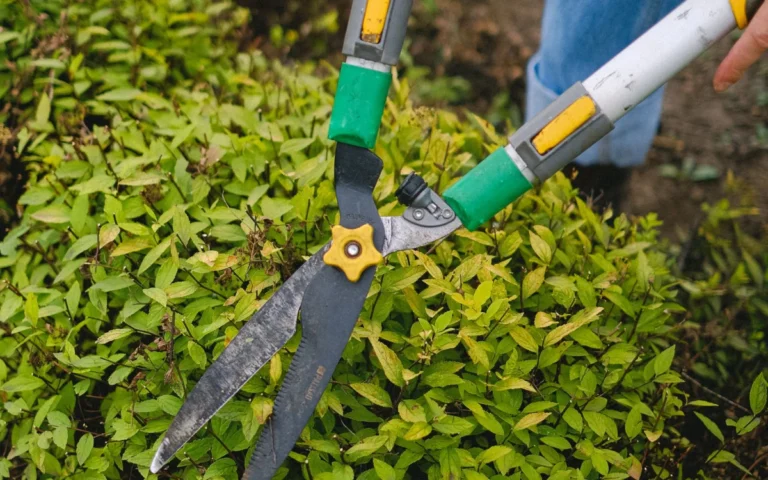
For the basics of where and how to make pruning cuts, see our guide on how to trim bushes; the same cutting rules apply to young trees.
Why Isn’t My Jacaranda Blooming?
- It’s too young. Seed-grown trees can take up to 10 years.
- Not enough sun. It needs full sun to flower well.
- Winters too warm or too cold. UF says flowering is best after some cool nights in the upper 30s; frost damage, on the other hand, can set it back.
- Cool, windy coastal site. Sea breezes can reduce flowering.
- It’s in a pot indoors. Potted indoor jacarandas often never bloom.
Jacaranda Tree Problems and Downsides
Before you plant one, know the trade-offs:
- Flower litter. Fallen flowers carpet the ground. Some people love the purple carpet; others hate the sticky, slippery mess on cars, decks and sidewalks.
- Surface roots that can lift paving and lawns.
- Breakable branches if the tree isn’t trained young.
- Size. It quickly outgrows small yards.
- Invasive in some countries. It is listed as invasive in parts of South Africa, Namibia and Queensland, Australia. In Florida, UF/IFAS currently assesses it as not a problem species (assessment updated January 2026).
7 Jacaranda Mistakes Real Owners Make (From Plant Forums)
These come up again and again in jacaranda threads:
- Planting it in a climate that’s too cold. Owners in cold areas lose trees to frost, or end up with a struggling, leafless indoor plant.
- Planting under power lines. It grows taller than the lines, and the heavy cuts needed afterward leave it misshapen.
- Planting over a driveway, sidewalk or parking spot. The sticky, slippery flower drop is a top complaint.
- Topping a fast-growing young tree. Cutting the top off causes a burst of weak shoots instead of a strong frame.
- Not choosing one main trunk. Young trees that split into several leaders (or get damaged) need one leader chosen early.
- Repotting or moving it and expecting no reaction. Curling and yellowing leaves after repotting are common; the tree usually needs weeks to settle.
- Expecting fast flowers from a seedling. A seed-grown tree can take up to a decade to bloom.
Is a Jacaranda Tree Toxic to Pets?
NC State’s Plant Toolbox lists the jacaranda as non-toxic to cats, dogs and horses, and Monrovia also lists it as non-toxic to cats and dogs. Still, don’t let pets chew on the pods or leaves, and call your vet if a pet eats a large amount of any plant.
FAQ
What growing zone does a jacaranda tree need?
USDA zones 9b to 11. In zone 9a and colder, grow it in a pot and protect it from frost.
How fast does a jacaranda tree grow?
Fast. Young trees can grow up to 10 feet a year in warm climates.
How long does it take a jacaranda to bloom?
Trees grown from seed can take up to 10 years. Nursery trees are already a few years old, so they usually bloom sooner.
Do jacaranda trees lose their leaves?
Yes, many drop most of their leaves in late winter or spring, just before or as they bloom. In mild areas they may keep some leaves (semi-evergreen).
Are jacaranda trees messy?
Yes. Expect heavy flower drop in spring, plus leaves and seed pods. Keep them away from pools, patios and parking spots.
Where is the jacaranda tree from?
South America, mainly Bolivia, Argentina, Paraguay and southern Brazil.
Final Thoughts
A jacaranda tree is one of the most beautiful flowering trees you can grow, if you live somewhere warm enough. Plant it in zones 9b–11, in full sun and well-drained soil, with plenty of room, away from paving and pools, and train it to one strong trunk while it’s young. Do that, and you’ll get your own purple show every spring.
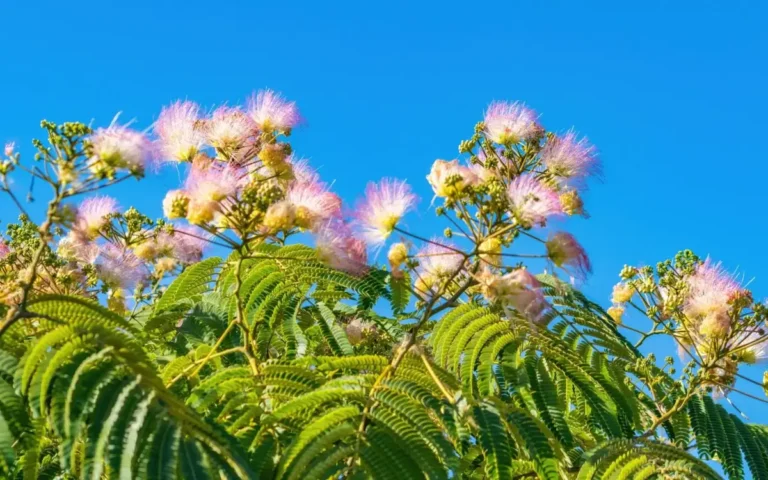
Looking at other flowering trees? Our mimosa tree guide covers the pink silk tree and why it’s invasive in much of the US.