How to Unclog a Shower Drain (Without Harsh Chemicals)

To unclog a shower drain, take off the drain cover and pull out the hair (that’s what blocks most shower drains). If it’s deeper, use a plastic barbed drain tool or a bent wire hanger, then a plunger or drain snake. Baking soda and vinegar can help with soap build-up. Only use boiling water if your pipes are metal, not plastic (PVC), and avoid chemical drain cleaners if you can.
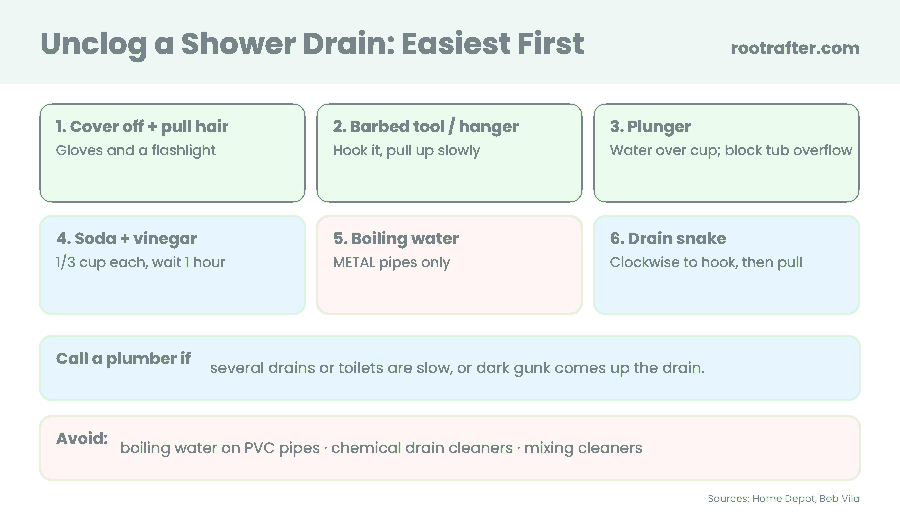
Quick Answer: Try These in Order
- Remove the drain cover and pull out any hair you can reach (wear gloves).
- Use a plastic barbed drain tool or a hooked wire hanger to fish out deeper hair.
- Plunge with a few inches of water over the drain.
- Baking soda and vinegar (1/3 cup each), wait at least 1 hour, then run hot water.
- Use a drain snake (hand auger) for clogs further down.
- Call a plumber if several drains are slow or water backs up elsewhere.
Home Depot lists its methods “from easiest to hardest,” and we follow the same idea: start simple and only move on if you need to.
Before You Start: Check Your Pipes
This matters for one method: boiling water.
- Home Depot: “Do not pour boiling water down PVC pipes, which can be damaged by the heat.”
- Bob Vila says boiling water on PVC “could cause joints to loosen.”
- How to check: Bob Vila suggests finding where the main drain line comes through the floor (often near the main water shut-off) and seeing whether it’s metal or plastic. Under-sink pipes are another clue.
If you’re not sure, skip boiling water and use hot tap water instead.
Step 1: Remove the Drain Cover
- Screw-in covers: “Some covers can be unscrewed with a screwdriver” (Home Depot).
- Pop-up covers: Bob Vila notes many drains have “push-pull, lift-and-turn, or toe-touch covers.” Most twist off counterclockwise, sometimes with a screw underneath.
- Snap-in covers: pry gently with a flat screwdriver, protecting the shower floor so you don’t scratch it (Home Depot).
Some drains have a cover that can’t be removed. You can still push a thin plastic drain tool through the slots.
Step 2: Pull Out the Hair
Most shower clogs are a ball of hair held together by soap.
- Wear rubber gloves and pull out what you can see. Use a flashlight to look down (Home Depot).
- Plastic barbed drain tool: a cheap, thin plastic strip with little teeth (sold as a “drain snake,” “zip tool” or “hair grabber”). Push it down, twist and pull up slowly. Reddit users say these clear most shower clogs.
- Wire hanger: straighten it and bend a small hook at the end (Home Depot, Bob Vila). Push it in until you feel resistance, then fish the clog out. Go gently so you don’t scratch the drain or push the hair further down.
Run hot water to check. In many showers, that’s the whole job done.
Step 3: Plunge It
- Clear the drain cover off.
- Run enough water to cover the lip of the plunger cup (Home Depot).
- For a better seal, Home Depot suggests a bit of petroleum jelly on the rim of the plunger.
- Shower-tub combo? Block the overflow hole (the round plate under the tap) with a wet rag first. Reddit plumbers point out that otherwise the pressure just escapes through it.
- Plunge firmly up and down several times, then check.
Use a flat-bottomed cup plunger, not a toilet plunger with a flange, and keep a separate one for the shower.
Step 4: Baking Soda and Vinegar
This works best on soap scum and gunk, not on a solid hair ball. Home Depot and Bob Vila give the same method:
- Mix 1/3 cup of baking soda and 1/3 cup of white vinegar in a heat-resistant cup.
- Pour it straight down the drain (cover removed).
- Let it sit for at least 1 hour.
- Flush with hot water.
Step 5: Boiling Water (Metal Pipes Only)
If your pipes are metal:
- Pour boiling water from a kettle a little at a time (Home Depot).
- Wait 10–15 minutes, then check whether the water drains (Bob Vila).
Plastic pipes? Use very hot tap water instead.
Step 6: Use a Drain Snake (Hand Auger)
For a clog deeper in the pipe:
- Feed the cable into the drain.
- Turn the handle clockwise to hook the clog (Home Depot, Bob Vila).
- Pull it back slowly, turning the other way to bring the clog out (Home Depot).
- Run hot water to test.
Reddit users warn that a snake that’s too thick may not fit through a shower trap. Choose a small hand auger made for sinks and showers.
What About Chemical Drain Cleaners?
We’d leave them for last, or skip them.
- Home Depot warns that chemical drain products “may cause damage to your pipes.” If you use one, wear gloves and eye protection, ventilate the room and tell your plumber what you used.
- Bob Vila says they won’t work if an object is causing the clog, and that overuse can weaken PVC pipes and corrode older metal pipes.
- Several Reddit users found that caustic cleaners made the clog worse or left them with a sink full of dangerous liquid.
- Never mix drain cleaners with each other, or with vinegar or bleach.
Standing Water in the Shower?
- Scoop or sponge out most of the water first so you can reach the drain.
- Start with Step 2 (pulling hair). Standing water usually means a thick clog near the top.
- Don’t pour chemicals into standing water.
When to Call a Plumber
- Several drains or toilets are slow or backing up. Home Depot says this, or “black gunk” coming up, can mean a sewer line blockage.
- An object (like a bottle cap or toy) went down the drain (Bob Vila).
- You’ve tried the plunger and snake and nothing works.
How to Stop It Clogging Again
- Fit a hair catcher or drain screen and empty it regularly (Home Depot, Bob Vila).
- Brush your hair before you shower so less ends up in the drain (Home Depot).
- Run baking soda and vinegar through the drain every month or two (Home Depot says monthly; Bob Vila says every couple of months).
- Metal pipes only: a kettle of boiling water about once a week (Home Depot).
- Heavy conditioners and oily soaps build up over time. Reddit plumbers say a weekly hot-water flush helps.
While you’re in there, our guide on how to clean shower tiles and grout covers the rest of the shower.
6 Shower Drain Mistakes Real People Make (From Forums)
- Pouring boiling water into PVC pipes. It can soften joints. Check your pipes first.
- Using chemicals first. They often don’t touch a hair clog and can damage pipes.
- Plunging a tub without blocking the overflow. The pressure escapes and nothing moves.
- Pushing the hair further down with a stiff wire instead of hooking it out.
- Using a snake that’s too thick for the shower trap.
- Ignoring other slow drains. That points to a main-line problem, not the shower.
FAQ
What dissolves hair in a shower drain?
Nothing safe dissolves hair quickly. Pulling it out with a barbed tool or hooked hanger is faster and safer than chemicals.
Does baking soda and vinegar unclog a shower drain?
It helps with soap build-up and light clogs. Use 1/3 cup of each, wait at least an hour, then run hot water.
Can I pour boiling water down my shower drain?
Only if your pipes are metal. Home Depot and Bob Vila both warn against boiling water on PVC pipes.
How do I unclog a shower drain without removing the cover?
Push a thin plastic barbed drain tool through the slots and pull up the hair, or try a plunger.
Why does my shower drain keep clogging?
Usually hair and soap. A hair catcher and a monthly baking soda and vinegar flush help prevent it.
Final Thoughts
Most shower clogs are just hair. Take off the cover, pull it out, and you’re usually done in five minutes. If not, work down the list: barbed tool or hanger, plunger, baking soda and vinegar, then a snake. Save chemicals for last, check your pipes before using boiling water, and fit a hair catcher so you don’t have to do this again.
Bathroom toilet acting up too? See how to unclog a toilet without a plunger or what to do when your toilet keeps running.